AT A GLANCE: KALKA-SHIMLA TOY TRAIN
| Route | Kalka to Shimla | 96 km |
| Duration | 5 to 6 hours |
| Gauge | Narrow – 2 ft 6 in |
| Tunnels / Bridges | 103 tunnels | 800+ bridges |
| Train Names | Himalayan Queen | Shivalik Express | Rail Motor |
| Booking | IRCTC | Up to 90 days in advance |
| Best Seat for Views | Right side going up | Left side coming down |
| UNESCO Status | World Heritage Site since 2008 |
The Kalka-Shimla toy train is one of the most breathtaking rail journeys in all of Asia – a slow, winding climb through pine forests, stone tunnels and Himalayan valleys that has been running since 1903. Declared a UNESCO World Heritage Site in 2008, this narrow-gauge railway is not just a mode of transport; it is a living piece of history that delivers views no road journey can match. Whether you are a first-time visitor to Shimla or a seasoned traveller to the hills, riding the toy train at least once is non-negotiable.
History of the Kalka-Shimla Railway
The story of the Kalka-Shimla railway begins in the era of the British Raj. Shimla served as the summer capital of British India from 1864, and the colonial administration desperately needed a reliable link between the plains and the hills. Road travel was slow and exhausting, so the decision was made to build a railway that could carry passengers, goods and government officials up the steep Himalayan gradients.
Construction began in 1900 under the direction of H.S. Harington and the line was formally opened on 9 November 1903. The engineering achievement was remarkable for its time. Workers had to blast through 103 tunnels, construct more than 800 bridges and lay 96 km of track across terrain that climbs from an altitude of roughly 656 metres at Kalka to 2,076 metres at Shimla station. The longest tunnel on the route – Tunnel 33 near Barog – stretches for 1,143 metres and has its own piece of folklore involving a British engineer named Colonel Barog, after whom the nearby town is named.
For more than a century the railway carried British officials, Indian travellers, hill-station tourists and mountain goods. It survived two World Wars, independence and partition, and the transformation of Shimla from imperial capital to state capital of Himachal Pradesh. In July 2008, UNESCO added the Kalka-Shimla Railway to its list of World Heritage Sites as part of the Mountain Railways of India inscription, cementing its global significance. Today it is operated by Northern Railway under Indian Railways and carries thousands of passengers every year.
Related Reading
The Route: Key Stops Between Kalka and Shimla
The 96 km journey from Kalka to Shimla is not simply a transfer – it is a carefully paced encounter with the lower Himalayas. The train passes through 20 stations in total, but several stops are worth knowing about in detail.
Kalka (656 m): The journey begins here. Kalka is connected to Delhi, Chandigarh and other major cities by broad-gauge rail, making it the natural interchange point. The station is well organised with separate platforms for the narrow-gauge toy train. Arrive at least 30 minutes before departure, especially during peak season. There is ample paid parking nearby if you are driving from Chandigarh (roughly 70 km away).
Barog (1,144 m): One of the most popular stops, Barog is famous for Tunnel 33 – the longest on the route at 1,143 metres. The station itself is a popular breakfast halt for early morning trains, with a small platform canteen serving tea and snacks. The town is named after the British engineer who allegedly made a costly miscalculation while surveying the tunnel’s alignment.
Solan (1,467 m): A sizeable hill town, Solan is known for its mushroom cultivation and the Solan Brewery – one of India’s oldest. The station here is a good midway marker and passengers can stretch their legs on the platform.
Kandaghat (1,400 m): A quieter stop surrounded by deodar trees. Kandaghat is popular with photographers for the sweeping valley views visible from the carriage windows just before and after the station.
Taradevi (1,980 m): Named after the Taradevi temple perched on the hilltop above, this station offers some of the most dramatic views of the entire journey. The temple itself is a short climb from the station and is considered highly auspicious by local devotees.
Shimla (2,076 m): The final destination. Shimla station sits at the lower end of the Mall Road ridge. From here, visitors can walk up the steps to the main bazaar or hire a porter to carry luggage. Taxis and cabs wait just outside the station forecourt.
Ask the resort about your dates and room needs.
Check current room options and inclusions directly with the resort.
Trains, Timings and Classes Available in 2026
Indian Railways currently operates several services on the Kalka-Shimla route. Each train has a different departure time, speed and class configuration. Here is a breakdown of the main services to know for 2026.
Himalayan Queen (Train 52455/52456): The flagship toy train service on this route, the Himalayan Queen departs Kalka in the morning and is the most popular choice for tourists. It typically takes around 5 hours and 30 minutes to complete the journey. The train offers AC Chair Car and First Class compartments, making it the most comfortable option. Book early as it fills up fast, especially between April-June and October-November.
Shivalik Express (Train 52451/52452): The Shivalik Express is often considered the most scenic option among regular travellers. It runs daily and offers both Chair Car and ordinary Second Class coaches. The timings mean you arrive in Shimla with the full afternoon and evening ahead of you – ideal for sightseeing.
Rail Motor (Various numbers): The Rail Motor is a smaller, faster diesel railcar that makes fewer stops. It is popular with business travellers and those with less time. The journey can be completed in around 4 hours. Fewer seats are available so booking in advance is strongly recommended.
Classes available across services:
- AC Chair Car (CC): Air-conditioned coaches with numbered reclining seats. The most comfortable and popular class for tourists.
- First Class (FC): Available on select trains. Compartments with cushioned seats and slightly more privacy.
- Second Class (2S): Unreserved or reserved bench seating at a lower fare. Fine for a short stretch but less comfortable for the full 5-6 hour journey.
Note: Timings are subject to seasonal adjustments by Northern Railway. Always confirm departure times on the IRCTC website or the National Train Enquiry System (NTES) at trainenquiry.com before travel.
Stay at Kufri Heritage Resort and Spa
Luxury 5-star resort at 2,622 metres – the perfect base for exploring Shimla and Kufri. Mountain views, spa, restaurant and bonfire evenings.
Check Latest Price NowHow to Book Kalka-Shimla Toy Train Tickets on IRCTC
Booking your toy train ticket in advance is strongly advised, particularly during summer holidays (April to June), the Diwali and Dussehra season (October), and Christmas-New Year week. Here is the step-by-step process for 2026.
Step 1 – Create or log into your IRCTC account. Visit www.irctc.co.in and log in. If you do not have an account, registration is free and takes around 5 minutes. You will need a valid email address and mobile number for OTP verification.
Step 2 – Search for the train. On the homepage, select the “Plan my Journey” tab. Enter “Kalka” as the source station and “Shimla” as the destination. Choose your travel date. IRCTC allows bookings up to 90 days in advance, so plan accordingly during peak season.
Step 3 – Choose your train and class. A list of available trains will appear with seat availability shown for each class. Select the train that suits your timing preference. Click on the class you want – CC for AC Chair Car is most popular – and proceed.
Step 4 – Enter passenger details. Add the names, ages and ID document numbers for all passengers. Indian nationals typically use Aadhaar, PAN or a passport. Foreign nationals must enter their passport number.
Step 5 – Pay and download your e-ticket. Complete payment via UPI, net banking, credit/debit card or IRCTC wallet. Your e-ticket will be sent by email and SMS. A printout is recommended but the digital version is accepted on board.
Tatkal booking: If you have missed the advance window, Tatkal quota opens one day before departure at 10 am for AC classes. Tatkal tickets carry a premium surcharge but are often the only option during busy periods.
Offline booking: Tickets can also be purchased at Kalka railway station counter or through authorised travel agents. Counter quotas are limited so this is not a reliable option during peak season.
Journey Experience and Photography Tips
The Kalka-Shimla toy train is one of the finest photography subjects in India. Here is how to make the most of the journey from both a visual and experiential standpoint.
Seat selection for views: This is the single most important thing to get right. If you are travelling from Kalka up to Shimla, book a seat on the right side of the carriage. The most dramatic valley views and mountain drops appear on that side as the train winds clockwise up the gradient. If you are travelling back down from Shimla to Kalka, switch to the left side. This is a consistent piece of advice from experienced travellers on this route and makes a significant difference.
The tunnel experience: Passing through 103 tunnels is an experience unlike any other rail journey in India. The sudden plunge into darkness, the roar of the engine echoing off stone walls and the burst of daylight at the other end happen repeatedly throughout the journey. Keep your camera ready at the tunnel entrances – the framing of the emerging landscape is one of the most iconic shots you can capture.
The mountain curves: Several sections of the track curve so sharply that you can lean out of the open door (with care) and photograph both the engine and the rear carriages in a single frame. The curve just before Barog and the series of bends approaching Taradevi are particularly photogenic.
Early morning light: If you can manage the early departure from Kalka, the golden morning light filtering through the pine and oak forests in the lower sections of the journey is exceptional. Mist often lingers in the valleys below Solan and Barog until mid-morning, creating a cinematic layered effect.
What to carry: The mountain air can be noticeably cooler than the plains even in summer, so carry a light jacket regardless of the season. A water bottle, snacks and a power bank for your phone are useful companions. The journey takes 5-6 hours and food availability inside the train is limited to the pantry car on some services.
Luggage: There is no strict luggage restriction as on flights but the carriages are narrow and overhead space is limited. Two medium-sized bags per person is a practical maximum. Large suitcases are cumbersome on board – consider shipping bulky luggage by road cargo if staying in Shimla for an extended period.
Getting to Kalka: From Delhi, Chandigarh and Beyond
Kalka is the critical gateway for the toy train and getting there efficiently from your starting point determines the success of your itinerary.
From Delhi (270 km): The most convenient option is to take the Shatabdi Express or Kalka Mail from New Delhi railway station directly to Kalka. The Shatabdi is particularly well-timed, departing early morning from Delhi and arriving in Kalka with enough time to board the Himalayan Queen. You can also drive via NH44 to Chandigarh and then continue on NH7 to Kalka, a journey of approximately 5-6 hours depending on traffic.
From Chandigarh: First reach Kalka, then change to the Kalka–Shimla train. The best connection depends on your actual starting point and live railway schedule; do not assume a fixed journey time or fare. Our Chandigarh to Shimla by train guide explains the CDG–KLK–SML booking sequence, airport arrivals and the onward Kufri transfer.
Parking at Kalka: If you are driving to Kalka and leaving your vehicle there while you travel to Shimla, paid parking is available near the railway station. The facility is managed and reasonably secure. However, if you plan to stay in Shimla for several days, using cabs or public transport between Chandigarh and Kalka and leaving your vehicle in Chandigarh is often a smarter arrangement.
Flying into Chandigarh Airport: For travellers coming from outside North India, Chandigarh Airport (IXC) is the nearest major airport with connections to Delhi, Mumbai and Bangalore. From the airport to Kalka by cab takes roughly 1 hour and 15 minutes.
From Shimla Station to Kufri Heritage Resort
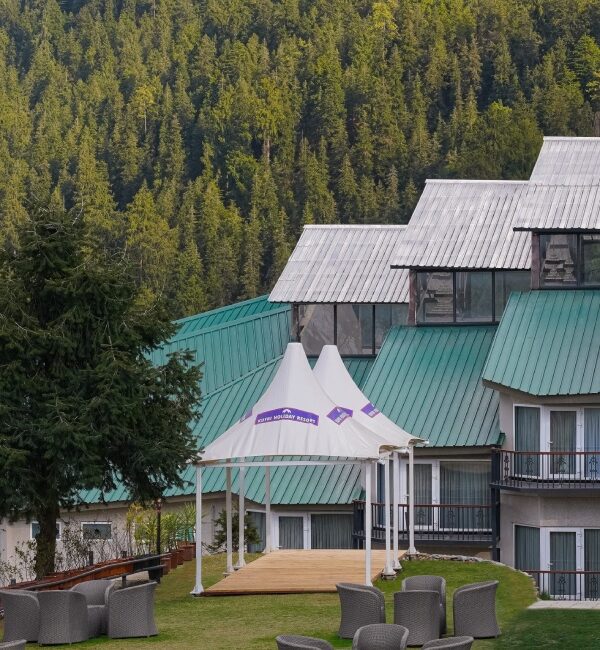
After the toy train pulls into Shimla station after your spectacular 96 km ascent, the next step for guests staying at Kufri Heritage Resort and Spa is straightforward. The resort sits at 2,622 metres in Kufri, approximately 13 km from Shimla’s Mall Road.
The most practical option is to hire a local cab from outside Shimla station. The drive from Shimla to Kufri takes between 30 and 45 minutes depending on traffic, and the route climbs steadily through Old Shimla, Chharabra and into Kufri. The road is paved throughout and well-maintained, passing through forest cover that signals the transition into real mountain terrain.
Kufri Heritage Resort and Spa can also arrange a pickup from Shimla station if you inform the front desk of your arrival details in advance. The resort’s location at 2,622 metres places it above Shimla itself, offering panoramic Himalayan views that are genuinely difficult to find at lower altitudes. After the long journey from the plains – first to Kalka, then five hours on the toy train, then the final climb to Kufri – arriving at the resort feels like a complete arrival into the mountains.
The resort serves as an ideal base for exploring not just Shimla but the wider Kufri area, including the Himalayan Nature Park, the Fagu viewpoint and, in winter months, the snow activities that have made Kufri famous among North Indian tourists. Mall Road Shimla is 13 km away and easily reachable by cab for day trips.
Plan Your Shimla and Kufri Visit
Kufri Heritage Resort and Spa is the ideal base for all Shimla-area sightseeing – 13 km from Mall Road, with direct access to Kufri snow activities and Himalayan Nature Park.
Call for Best PriceChandigarh to Shimla by toy train
There is no rail line into the Shimla hills themselves. Trains stop at Kalka at the foot of the climb, and the UNESCO-listed Kalka-Shimla toy train takes over from there, about 5 to 6 hours of small stations, tunnels and cedar forest. Chandigarh sits roughly 45 minutes by road from Kalka, so the usual pattern is a car to Kalka and the little train up the hill.
Seats are limited by the size of the rail cars, and snow-season and summer dates sell first, so book the Kalka-Shimla leg on IRCTC early and confirm the current departure there; timings move with the season. The road alternative is set out above: NH-5 through Kalka, Solan and Kandaghat in 3 to 4 hours.
Riding the train up? Keep the same plan either way: Kufri is 13 km beyond Shimla, and a taxi from the station covers it in 30 to 45 minutes.
Frequently Asked Questions
How much does a Kalka-Shimla toy train ticket cost?
Ticket prices vary by class and train. Second Class (2S) is the most affordable option, while AC Chair Car (CC) is mid-range and First Class (FC) costs more. Prices are set by Indian Railways and are subject to revision. For the latest fares, check the IRCTC website at the time of booking or on request guidance through your travel agent.
Which train is best for the Kalka-Shimla journey?
The Himalayan Queen is widely considered the best toy train for tourists due to its morning departure timing, comfortable AC Chair Car and First Class options, and good punctuality record. The Shivalik Express is a close second and is particularly popular with travellers who want to arrive in Shimla with the afternoon free. The Rail Motor is best for those who prioritise speed over the leisurely experience.
How do I book Kalka-Shimla toy train tickets online?
All bookings are made through IRCTC at www.irctc.co.in. You will need a registered account with a valid email and mobile number. Advance booking opens 90 days before the date of travel – during peak season (April-June and October-November) it is strongly advised to book as early as possible as popular trains fill up within days of the booking window opening.
Can I take luggage on the toy train?
Yes, luggage is allowed on the Kalka-Shimla toy train. There is no formal weight restriction comparable to airlines, but the narrow carriages have limited overhead and under-seat space. Two medium-sized bags per person is a practical limit. Avoid large hard-shell suitcases as they are difficult to manoeuvre in the compact interiors. Porters are available at both Kalka and Shimla stations to help with heavier bags.
Is the toy train better than travelling to Shimla by road?
For the experience itself, yes – the toy train is significantly better. The 103 tunnels, 800+ bridges and Himalayan panoramas visible from the carriage windows simply cannot be replicated from a road vehicle. Road travel is faster (2.5 to 3 hours versus 5 to 6 hours by train) and more flexible if you need to stop along the way, but the toy train journey is widely regarded as one of the defining travel experiences in North India and a UNESCO World Heritage route that deserves to be taken at least once.
Choose a stay that fits your itinerary
Check your travel dates and room preferences directly before booking.