AT A GLANCE: FAGU NEAR SHIMLA
| Distance from Shimla | 22 km via NH-5 (Shimla-Narkanda Highway) |
| Distance from Kufri | 12 km | approx 20 minutes by road |
| Altitude | 2,450 metres above sea level |
| Main Attraction | Apple orchards and forest trekking |
| Apple Blossom Season | April to May |
| Apple Harvest Season | July to September | Entry: Free |
Tucked along the Shimla-Narkanda highway at an altitude of 2,450 metres, Fagu is one of those rare Himachali villages that still feels genuinely untouched. While Kufri draws crowds for its ski slopes and Shimla pulls visitors to its colonial promenade, Fagu sits quietly between them - terraced apple orchards climbing the hillside, deodar forests pressing in on either side of the road, and sweeping views of the Shimla valley spread below. Most travellers pass right through on the way to Narkanda. The ones who stop discover one of the most rewarding short detours in all of Himachal Pradesh.
For 2026, Fagu is exactly the kind of place that rewards the curious traveller. Whether you are timing your visit for the pink-and-white blush of apple blossoms in April and May, arriving during the golden harvest between July and September, or simply looking for a quiet forest walk far from the usual Shimla tourist circuit - Fagu delivers. This guide covers everything you need to know, including how to reach Fagu from Kufri and Shimla, what to do on arrival, when to visit, and what to bring home.
What Is Fagu - The Apple Orchard Village on NH-5
Fagu is a small agricultural settlement that sits directly on National Highway 5, the old Hindustan-Tibet Road that winds from Shimla up through Narkanda and eventually toward Kinnaur. The highway position means Fagu has always been a waypoint rather than a destination - which is precisely what has preserved its character so well. There are no large hotels here, no crowded souvenir markets, no entry fees or ticketed attractions. What you get instead is a working Himachali village where apple farming has been the backbone of local life for generations.
The landscape around Fagu is defined by its orchards. From roughly October through March the trees stand bare and sculptural against the winter sky. Then spring arrives and transforms everything. By mid-April the apple trees are in full blossom - thousands of flowers in shades of white, pale pink and rose clustered along every branch. The fragrance carries through the cool mountain air and the hillsides look like something out of a Japanese woodblock print. This short window of three to four weeks is widely considered the most beautiful time to visit Fagu, and photographers and nature lovers travel specifically to catch the bloom.
By summer the blossoms give way to dense green foliage and the developing fruit. The harvest begins in earnest from July onward. By August and September the orchards are heavy with apples - Royal Delicious, Red Delicious and Golden varieties are all grown in the area. Local families are busy picking, grading and packing for markets across northern India. Visitors during harvest season can often purchase freshly picked apples directly from farmers at prices far below anything you would find in a city market. The apples here have a crispness and flavour that comes from cool nights and clean mountain air - noticeably different from what you buy in the plains.
Beyond the orchards, Fagu sits at the edge of dense mixed forest. Deodar cedar, oak and rhododendron cover the slopes above and below the village. This forest backdrop is what gives Fagu its second major draw - trekking. The trails here are not difficult, but they are genuinely scenic and almost entirely free of tourist crowds even in peak season.
Apple Blossom Photography and the Orchard Walk
The orchard walk at Fagu is informal by design. There is no marked trail, no entry booth and no guided tour waiting for you. You simply park or step off the road, follow the narrow paths that wind between the terraced orchards, and explore at your own pace. This informality is part of the appeal - the experience feels personal and unhurried in a way that more developed tourist attractions rarely manage.
The orchards are laid out on terraced hillside plots, each level supported by dry-stone walls. Walking between the rows during blossom season places you right inside the bloom. The light in the morning hours - roughly 7 to 10 AM - falls softly on the white and pink flowers, making this the preferred time for photography. By midday the light becomes harsher but the views across the valley open up beautifully. Late afternoon offers a warm golden tone that suits wide landscape shots showing the orchards against the distant ridgelines.
A few practical notes for the orchard walk: the paths between plots can be narrow and uneven, so proper footwear matters. The terraces drop away steeply in places - watch your footing and keep children close. Local farmers are generally friendly and accustomed to visitors passing through during blossom and harvest seasons, but it is courteous to stay on the paths between plots rather than walking directly through someone's orchard without acknowledgment. A simple greeting goes a long way.
During the harvest season the dynamic shifts slightly. You may be able to buy apples directly from a farmer - simply ask if they are selling. Prices are negotiable and the quality is exceptional. You can also buy locally made apple jam and preserves from small roadside stalls near the village. Himachali apple jam made from hill-grown fruit has a depth of flavour that supermarket versions simply cannot replicate - it makes an excellent gift to bring back from a Shimla trip.
Trekking Around Fagu - Forest Trails and Valley Views
The forest trails around Fagu offer some of the most accessible mountain trekking in the Shimla region. Unlike the commercial adventure activities you find at Kufri, trekking in Fagu is self-guided, free and genuinely quiet. The trails range from short 2 km loops through the deodar forest to longer 4 km circuits that climb through mixed woodland and open onto ridge-top viewpoints overlooking the Shimla valley.
The most popular route begins just above the main highway and climbs steadily through deodar forest for roughly 30 to 40 minutes before reaching a clearing with an unobstructed view toward Shimla. On a clear day you can see the city's characteristic ridge-top skyline - Christ Church visible as a distant silhouette - set against the deeper ranges beyond. The trail is not technical and requires no special equipment beyond comfortable walking shoes and a water bottle. The forest canopy keeps the walk cool even in summer, and the scent of deodar resin mixed with mountain air is part of what makes the experience memorable.
A slightly longer variant continues past the viewpoint and circles back through the upper orchards, returning to the highway about 500 metres from the starting point. This 4 km loop takes approximately two hours at a relaxed pace and covers a good cross-section of what makes Fagu's landscape distinctive - deep forest, open orchard terraces, and mountain panoramas. The route involves some moderate elevation gain and a few steeper sections but nothing that would challenge a reasonably fit adult.
For families travelling with children, the lower forest loop - staying close to the road and keeping to gentler gradients - offers a satisfying 45-minute walk without any serious ascent. The bird life in the deodar forest is excellent: Himalayan woodpeckers, laughing thrushes and kalij pheasants are all regularly seen here. Birdwatchers visiting in April and May will find the dawn chorus particularly rich.
One important practical note: there are no formal trail markers in Fagu and no rescue infrastructure. This is not the place for solo adventurers who are unfamiliar with mountain terrain. Go with at least one other person, carry a fully charged phone, let someone at your hotel know your route, and turn back if weather changes suddenly. Mountain conditions at this altitude can shift quickly, particularly during the monsoon months of July and August.
The View from Fagu - Shimla Valley Panorama
Among all the viewpoints in the wider Shimla region, the outlook from Fagu is one of the most expansive and least visited. The village sits on a ridge that commands a broad sweep of the Shimla valley on one side and the deeper Himalayan ranges on the other. From the right vantage point - either the hillside above the orchards or the ridge reached by the main forest trail - you can see the Shimla ridgeline to the south-west, the dark green shoulders of Jakhu Hill, and on clear winter days the snow-covered peaks of the higher Himalayas forming a white wall along the northern horizon.
The best visibility typically comes in October and November, after the monsoon has cleared the haze from the valleys. April and May also offer good conditions before the summer dust builds up. December and January bring the possibility of snow on the ground at Fagu itself - the orchards under snow with the higher peaks visible beyond is a spectacular combination, though road conditions on NH-5 require caution at those times of year.
Sunrise is exceptional from Fagu in clear weather. The first light catches the higher ridges to the north and east, turning the snow peaks pink and gold before the valleys below emerge from shadow. If you are staying at Kufri - just 12 km away - it is entirely practical to drive up to Fagu before breakfast, watch the sunrise from above the orchards, and return for a late breakfast. The 20-minute drive on a quiet morning highway is straightforward.
Stay at Kufri Heritage Resort and Spa
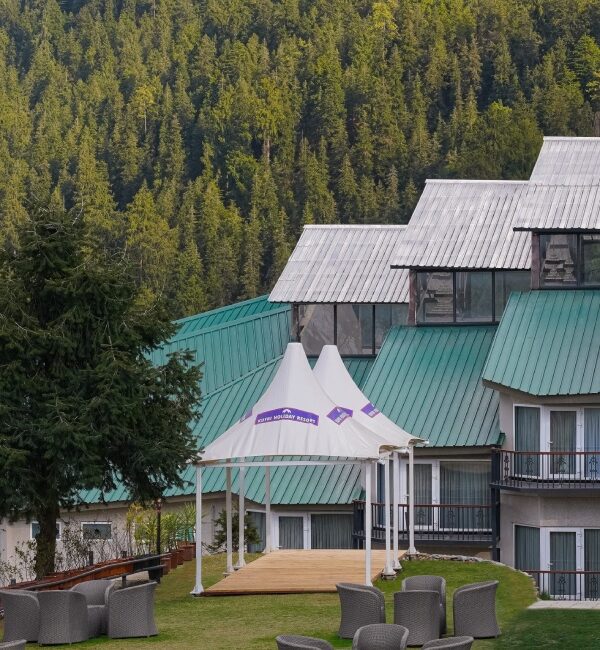
5-star luxury at 2,622 metres - 13 km from Shimla. Spa, restaurant, mountain views and bonfire evenings.
Check Latest Price NowHow to Reach Fagu from Kufri and Shimla
Fagu is straightforward to reach by road and the journey itself is part of the pleasure. From Kufri, the distance is 12 km along NH-5 heading toward Narkanda. The road climbs gently through the Kufri market area, passes through the small settlement at Chharabra, and then runs along the ridge through apple-orchard country to Fagu. In good road conditions the drive takes approximately 20 minutes. The highway is well maintained for most of the year, though winter snowfall between December and February can create icy patches - drive accordingly and check conditions before setting out in cold months.
From Shimla city the distance is 22 km along the same NH-5 highway. Starting from the bus stand area in Shimla, the drive takes 40 to 50 minutes depending on traffic through the city's narrow approach roads. The stretch from Kufri onward is faster and more open. Most visitors from Shimla combine Fagu with Kufri on the same day - the two destinations complement each other naturally, with Kufri offering the adventure and forest activities and Fagu offering the orchard and valley-view experience.
Public transport options exist but are limited. State buses running the Shimla-Narkanda route stop at Fagu, and shared taxis cover this corridor regularly. Private taxis from Shimla or Kufri are the most flexible option and fares are reasonable for a day trip. If you are staying at Kufri Heritage Resort, the front desk can arrange transport to Fagu and other nearby attractions.
There is ample roadside parking at Fagu for private vehicles. No parking fee is charged. The village itself is small enough that most points of interest are walkable from wherever you leave your vehicle.
What to Buy at Fagu - Local Himachali Produce
Shopping at Fagu is a low-key but genuinely rewarding activity. The village does not have a market in the conventional sense - no rows of souvenir shops, no aggressive vendors. What you find instead are small roadside stalls and occasional direct sales from farm households, particularly during the harvest months from July through September.
Fresh Himachali apples are the obvious purchase. The varieties grown around Fagu - Royal Delicious, Red Delicious and Golden Delicious among others - are harvested at altitude where cool nights and clean air produce fruit with outstanding flavour and texture. Buying a bag or two directly from a local grower during harvest season supports the farming families who have maintained these orchards for decades and gives you apples that are as fresh as it gets. Prices per kilogram at farm level are significantly lower than anything you would pay in a city supermarket.
Apple jam and preserves made by local women's self-help groups are also available at various points along this stretch of highway. Himachali apple jam has a concentrated, slightly tart character that is distinctly different from commercial varieties. A few small jars make practical and lightweight souvenirs that pack easily. Some stalls also offer dried apricots and walnuts sourced from further up the valley - these are worth trying and carrying back as well.
Local honey is another product associated with this part of the highway. Beekeeping alongside apple orchards is traditional in this region - the bees feed on the apple blossoms and the orchards benefit from pollination. The resulting honey has a mild floral quality. Look for stalls displaying jars of amber-coloured mountain honey, particularly in spring and early summer.
Plan Your Shimla and Kufri Trip
Kufri Heritage Resort and Spa - the ideal base for all Shimla-area sightseeing and Kufri activities.
Call for Best PriceFrequently Asked Questions: Fagu near Shimla 2026
Q: Is Fagu worth visiting as a day trip from Shimla or Kufri?
Yes, Fagu is well worth a half-day excursion from either Shimla or Kufri. The combination of terraced apple orchards, forest trekking trails and expansive valley views offers a genuinely different experience from the more commercialised attractions in the area. The short drive - 22 km from Shimla and just 12 km from Kufri - makes it easy to combine with other sightseeing without dedicating an entire day.
Q: What is the distance from Shimla to Fagu and how long does it take?
Fagu is 22 km from Shimla city along NH-5, the Shimla-Narkanda highway. The drive typically takes 40 to 50 minutes by private vehicle, depending on traffic through Shimla's approach roads. From Kufri the distance shrinks to 12 km and the drive takes approximately 20 minutes on a clear run along the highway.
Q: When is the best time to see apple blossoms at Fagu?
The apple blossom season at Fagu runs from mid-April through May, with peak bloom typically occurring in the last two weeks of April. During this window the orchards are covered in white and pale pink flowers and the fragrance in the morning air is remarkable. Early morning visits - arriving by 8 AM if possible - give you the best light for photography and the quietest conditions before day-trip traffic builds up.
Q: Can visitors pick apples at Fagu during the harvest season?
Visitors cannot freely pick apples from the orchards - the fruit belongs to farming families who depend on the harvest for their livelihoods. However, during the harvest season from July through September it is often possible to buy freshly picked apples directly from local growers at very reasonable prices. Approach farmers respectfully and ask if they are selling - most are happy to do so. This is a far better option than picking, as it supports the local economy directly.
Q: How difficult are the trekking trails at Fagu?
The forest trails around Fagu range from easy to moderate. The shorter 2 km loop through the deodar forest stays on relatively gentle gradients and is suitable for most adults and older children with basic fitness. The longer 4 km circuit involves some moderate ascent with steeper sections and takes roughly two hours at a relaxed pace. No technical skill or specialist equipment is needed for either route - comfortable walking shoes, water and sun protection are sufficient for a day visit.